






The haunting sounds and secret lives of the Colobus Monkey.
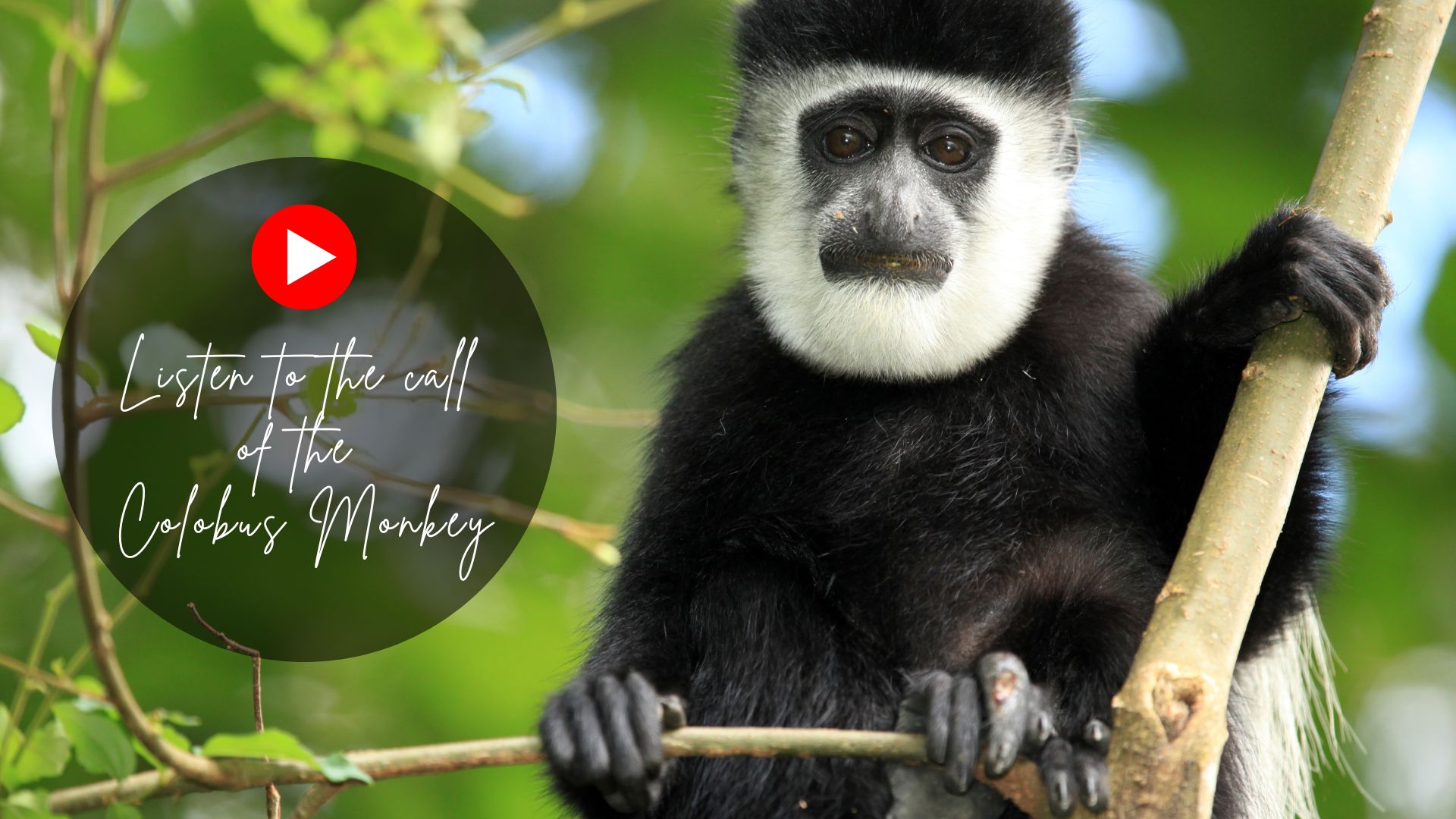
Long before you see a colobus monkey, you usually hear one. It begins as a low, resonant call rolling through the forest canopy, somewhere between a cough, a roar, and the creaking groan of old timber under strain. In the stillness of dawn, particularly in many of Tanzania’s montane forests, the sound can feel strangely prehistoric. It travels through mist and tangled fig trees, through branches dripping in orchids and mist droplets, sprawling vines, and carrying far deeper into the forest than the animal itself ever reveals.
For many travellers, the first instinct is to search for something much larger, eventually, high in the canopy, a flicker of black-and-white fur appears. A tail drapes impossibly long through the leaves. A face emerges briefly from the foliage, calm, almost contemplative, perhaps a little cheeky, before vanishing again into the treetops. The colobus monkey is one of Africa’s most visually striking primates, yet also one of its most elusive. Unlike baboons or vervet monkeys, colobus rarely descend to the ground. They inhabit the upper architecture of forests almost exclusively, moving with astonishing grace through layers of canopy that most humans barely notice. To observe them properly is to look upward and slow down.
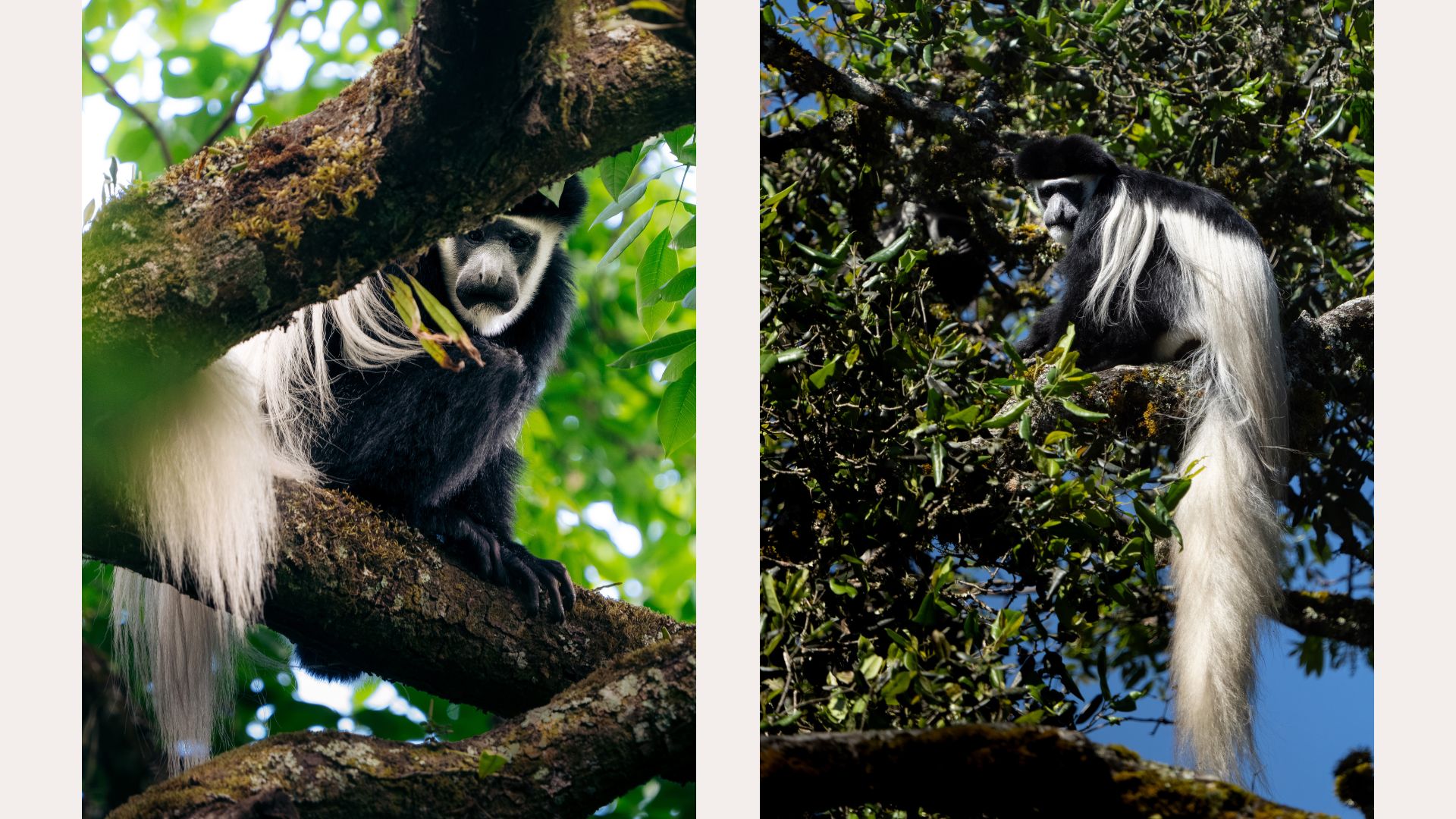
At Koroi Forest Camp, where ancient forest edges meet the jagged ridges of Mount Meru’s inclining slope – those sounds form part of the landscape itself. The calls of colobus monkeys drift through the trees at dawn and late afternoon, woven into birdsong, wind, and the distant movement of larger creatures below the canopy. They are not simply inhabitants of the forest. In many ways, they are indicators of its health.
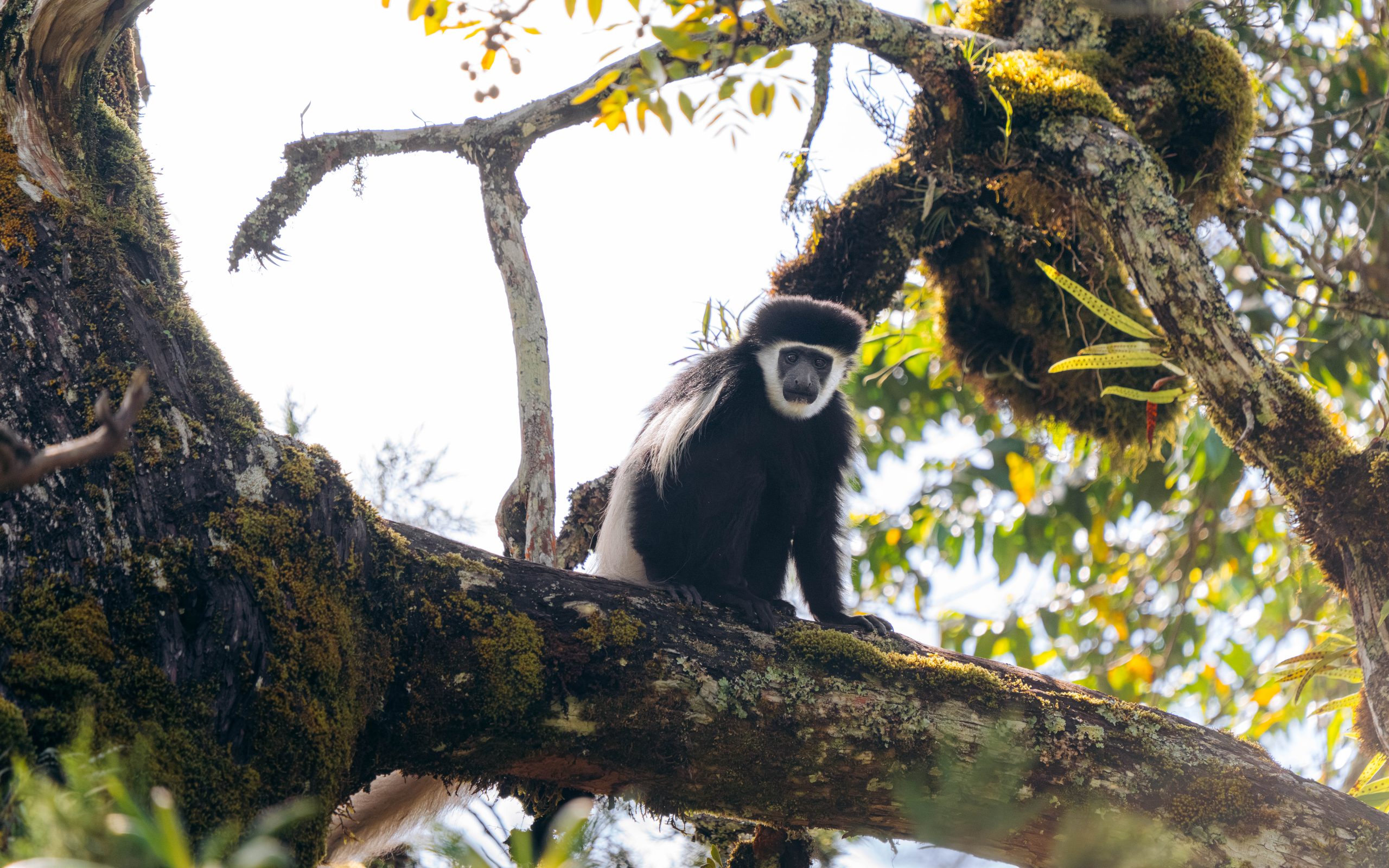
This is because colobus monkeys are specialists. Their survival depends on mature, relatively undisturbed forests with stable canopies, diverse tree species, and healthy leaf production year-round. Unlike many primates, colobus monkeys primarily eat leaves, a surprisingly difficult diet to sustain. Leaves are abundant, but nutritionally inefficient and often chemically defended by plants. To cope with this, colobus monkeys evolved highly specialized, multi-chambered stomachs capable of fermenting tough foliage in a way remarkably similar to cattle. It is an elegant adaptation, but also a limiting one. Where forests become fragmented, degraded, or too heavily disturbed, colobus populations often decline quickly. They cannot adapt as easily as more opportunistic monkey species that forage widely or rely on human-altered environments. Their presence therefore tells an important story, that this forest still functions.
Healthy forests matter far beyond their boundaries, montane and groundwater forests throughout East Africa act as climate stabilizers, carbon stores, water regulators, and biodiversity reservoirs. They protect soils, feed rivers, and create microclimates that sustain countless species – many of which remain unseen by most visitors. Colobus monkeys occupy just one visible strand within a much larger ecological network.
Yet for all their ecological importance, what makes colobus monkeys so captivating is often their social complexity. Their groups are structured around intricate hierarchies and long-term bonds, with grooming sessions that can stretch on for hours beneath the canopy. Mothers remain intensely attentive to their infants, whose bright white coats at birth make them appear almost like entirely different species. As they mature, that striking black-and-white fur takes on an almost theatrical elegance, the older colobus draped in flowing white mantles that can feel strangely reminiscent of a polished woman wrapped in couture fur at a Parisian café. The young move through the branches with reckless confidence, while older adults navigate the canopy with the measured precision of animals that have spent a lifetime suspended above the forest floor.
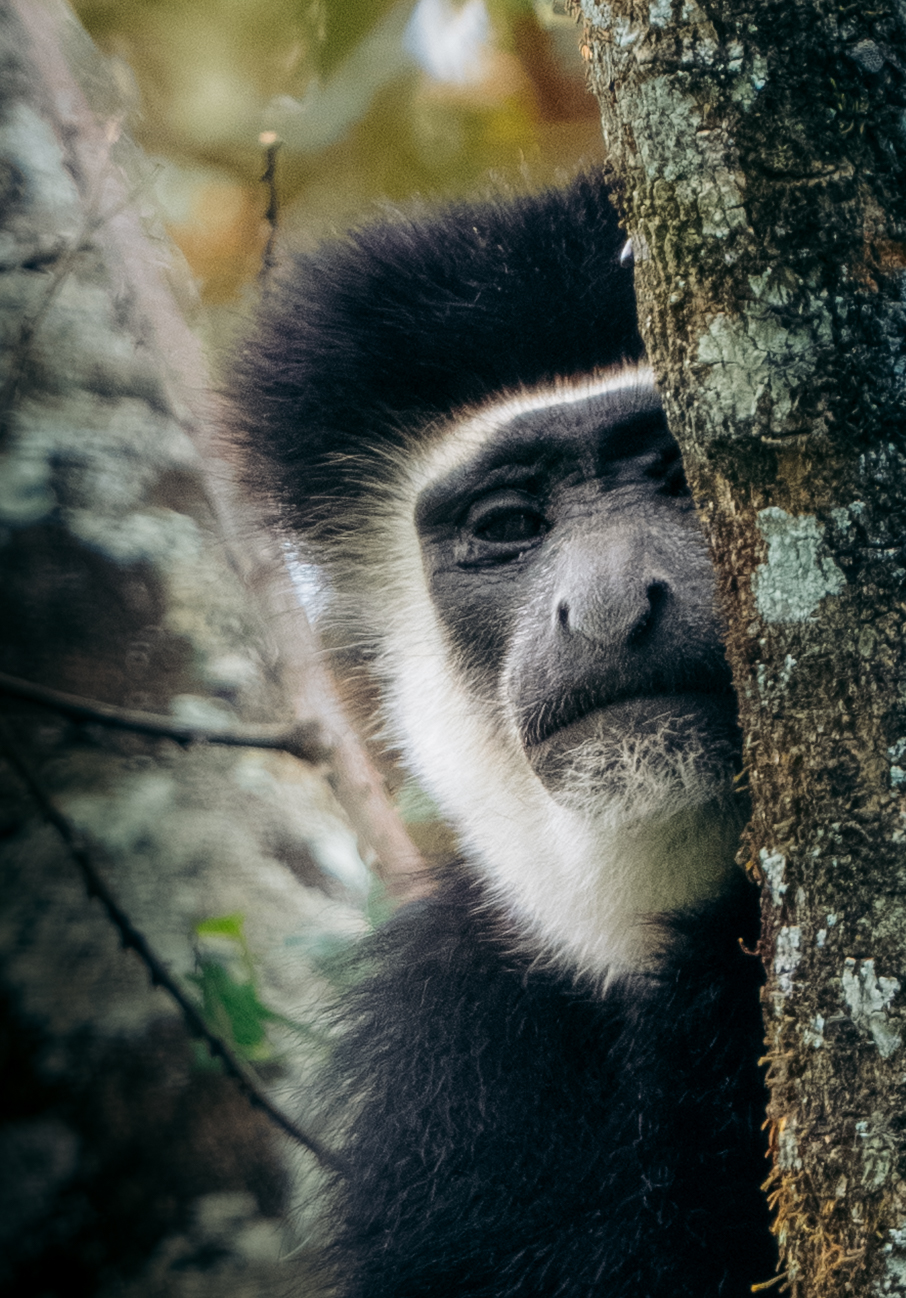
Communication within these groups extends far beyond the haunting territorial calls heard across the forest. Colobus monkeys rely on posture, facial expression, subtle vocalizations, movement, and even silence to maintain social cohesion. Alarm calls differ depending on the type of predator. Contact calls help groups navigate dense canopy where visibility disappears within meters. Dominant males use deeper resonant calls not only to defend territory, but to announce stability and presence across the forest. To human ears, these sounds often carry an emotional quality difficult to explain. There is something ancient in them, not dramatic or theatrical like a lion’s roar, but atmospheric. The sound belongs to forests that still operate according to rhythms older than roads, fences, or tourism. Perhaps that is why hearing colobus monkeys in the wild feels so memorable. Not because the animals demand attention, but because they seem almost indifferent to it.
They continue their lives high above the forest floor whether humans are present or not. They feed, rest, groom, argue, nurture, and call through the canopy much as they have for thousands of years. To encounter them is less like watching a performance and more like briefly witnessing a world already in motion, and increasingly, that matters.
Across Africa, forests face mounting pressure from agriculture, logging, charcoal production, and expanding development. In many regions, primates become among the first visible indicators of ecological strain. Silence replaces calls. Canopies thin. Movement corridors disappear. The absence of colobus monkeys can signal a forest losing its balance long before humans fully register the consequences themselves, which makes their presence all the more meaningful.
At places like Koroi Forest Camp, the sound of colobus calls drifting through the trees is more than atmosphere. It is evidence, and a constant reminder, of continuity, of a forest still intact enough to support complex life above the canopy, even as the modern world presses steadily closer around it. Perhaps that is, after all, the quiet magic of colobus monkeys themselves. They remind us that some of the most important signs of wilderness are not always the loudest or most obvious. Sometimes they are hidden high in the trees, carried softly through the mist before sunrise, reverberating around us in spine-tingling choruses, a reminder that this is still their home.


